“I came in here with like a stone… and then… shaped it into a statue.”
That’s how one student described the Coming of Age experience at All Souls—not as something that gave them new beliefs, but as something that helped shape what was already there.
Over the course of the program, students are invited to reflect on their values, their questions, and their understanding of the world around them. The result is a credo—a personal statement of belief—that each student will share with the congregation on April 12. But the real work isn’t in writing the words. It’s in figuring out what those words mean.
For many students, that process begins with something familiar but undefined.
“It was just floating around in my head… all these pieces that I just kind of had to piece together.”
Coming of Age doesn’t hand students a set of answers. Instead, it creates space to reflect, ask questions, and begin making sense of ideas that may have been sitting just below the surface for years.
That clarity often comes through writing.
“I know what I believe… but putting it on paper actually solidified it and put it into perspective.”
What starts as something abstract—feelings, instincts, values—begins to take shape through language. Writing becomes more than an assignment; it becomes a way of understanding.
“Writing my credo… gave me time to actually process stuff in my brain and lay it out into wording that makes sense to me.”
That process expands beyond the classroom.
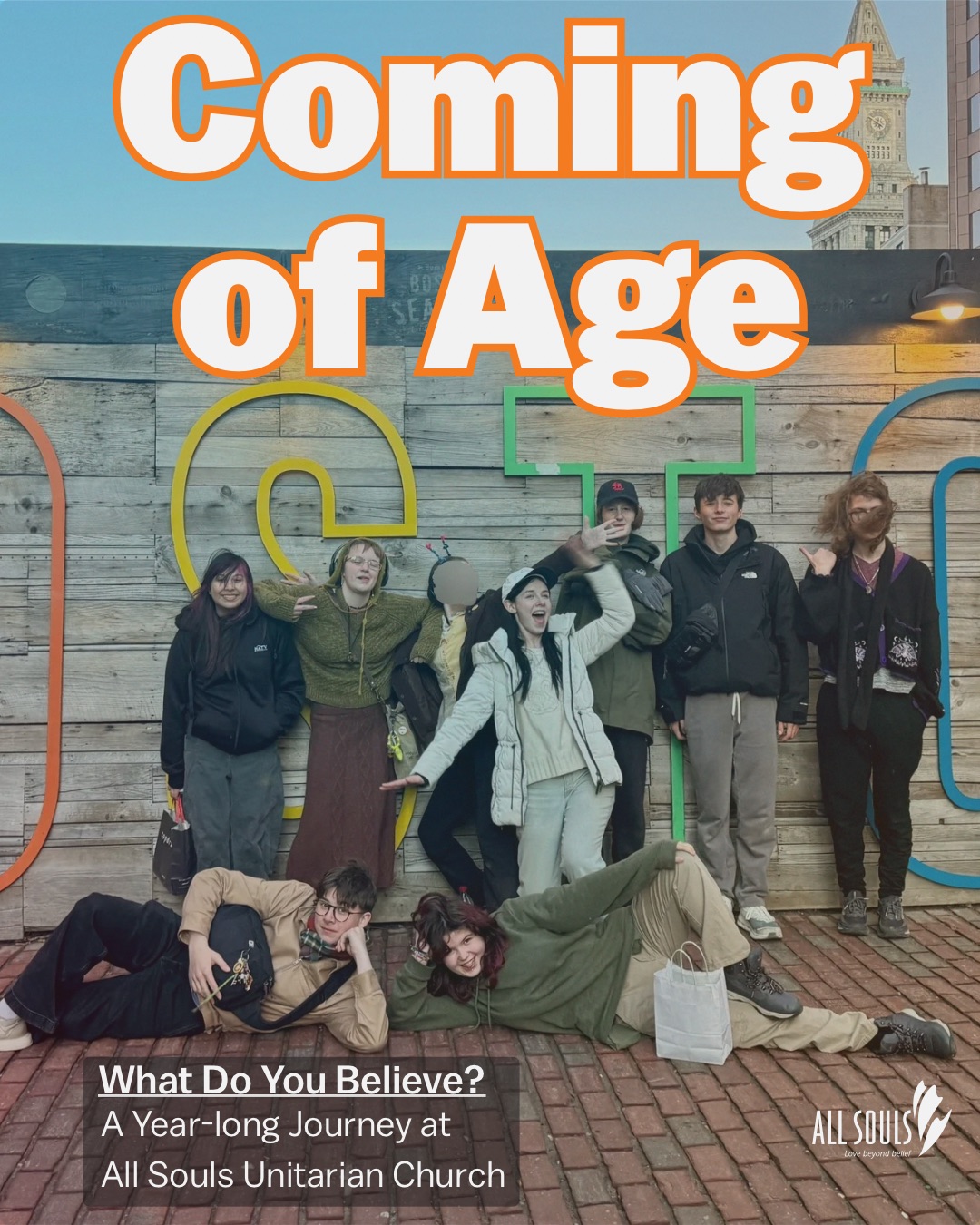
As part of the Coming of Age journey, students travel to Boston—home to much of Unitarian history—and explore the roots of a tradition built on freedom of belief, questioning, and personal responsibility.
One of the most meaningful moments comes at Walden Pond, where students are given time to step away on their own, journal in hand, and begin shaping their credos.
In the same place where Henry David Thoreau once reflected on life, purpose, and simplicity, students are invited to do something similar: slow down, pay attention, and consider what they believe.
In that stillness, ideas that once felt scattered begin to connect. Thoughts become sentences. Beliefs become something they can return to, revise, and eventually share.
And now, that process is leading to something new.
Because understanding what you believe is one thing. Saying it out loud is another.
In just a three minutes, each student is asked to do something that even many adults find difficult—to stand in front of a congregation and speak honestly about their values, their questions, and the way they see the world.
As they prepare to share their credos, there’s also an understanding that what they’re expressing isn’t fixed or final.
“This credo… is a snapshot in time. Your beliefs will be different a year from now, six months from now.”
The goal isn’t certainty. It’s awareness.
On Sunday, April 12, each student will stand and share what they believe—not as a final answer, but as an honest expression of who they are right now.
And in that act—of speaking clearly, of naming something deeply personal—belief becomes something more than an internal feeling.
It becomes a voice.
For students who will come after them, that journey is just beginning.
Each year, a new class of 9th graders steps into the Coming of Age program—bringing their own questions, perspectives, and voices.
To learn more about the program or how to get involved, reach out to Corey Smith at [email protected]